TYBAF SEM 5 IKS Question Paper OCT 26 – Mumbai University
Table of Contents
TYBAF SEM 5 IKS Question Paper OCT 26
TYBAF SEM 5 IKS Question Paper OCT 26 Download PDF
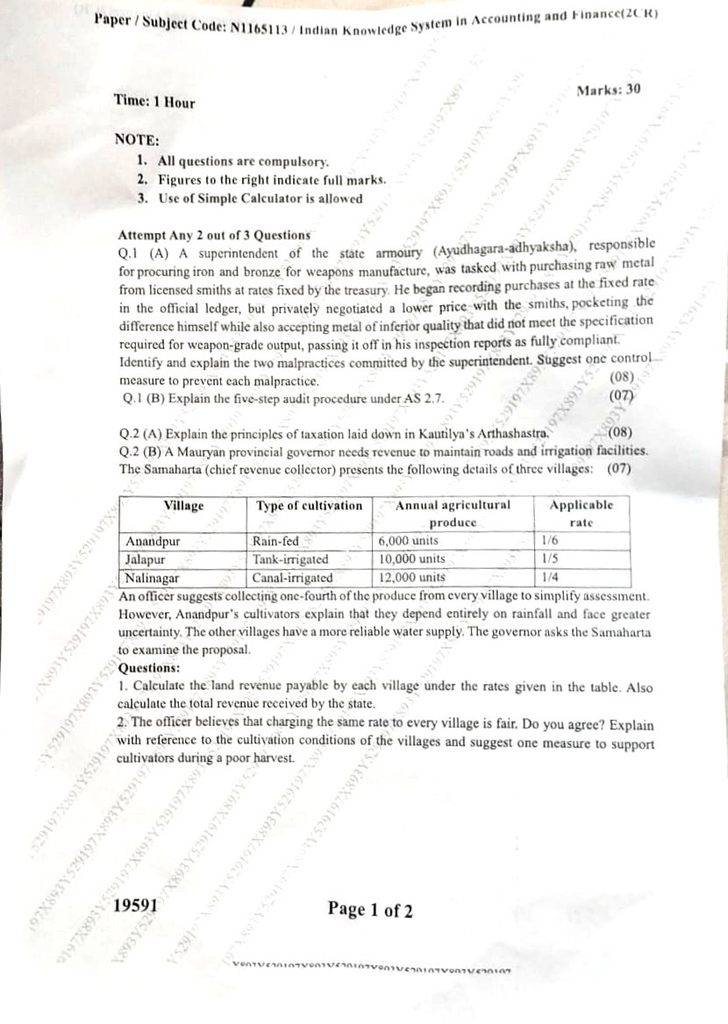
Duration: 1 Hour
Answer any 2 out of 3
Marks: 30
- All questions are compulsory.
- Figures to the right indicate full marks.
- Use of Simple Calculator is allowed
Attempt Any 2 out of 3 Questions
Q.1 (A) A superintendent of the state armoury (Ayudhagara-adhyaksha), responsible for procuring iron and bronze for weapons manufacture, was tasked with purchasing raw metal from licensed smiths at rates fixed by the treasury. He began recording purchases at the fixed rate in the official ledger, but privately negotiated a lower price with the smiths, pocketing the difference himself while also accepting metal of inferior quality that did not meet the specification required for weapon-grade output, passing it off in his inspection reports as fully compliant.
Identify and explain the two malpractices committed by the superintendent. Suggest one control measure to prevent each malpractice. (8 Marks)
Q.1 (B) Explain the five-step audit procedure under AS 2.7. (7 Marks)
Q.2 (A) Explain the principles of taxation laid down in Kautilya’s Arthashastra. (8 Marks)
Q.2 (B) A Mauryan provincial governor needs revenue to maintain roads and irrigation facilities. The Samaharta (chief revenue collector) presents the following details of three villages: (7 Marks)
| Village | Type of Cultivation | Annual Agricultural Produce | Applicable Rate |
| Anandpur | Rain-fed | 6,000 units | 1/6 |
| Jalalpur | Tank-irrigated | 10,000 units | 1/5 |
| Nalinagar | Canal-irrigated | 12,000 units | 1/4 |
An officer suggests collecting one-fourth of the produce from every village to simplify assessment.
However, Anandpur’s cultivators explain that they depend entirely on rainfall and face greater uncertainty. The other villages have a more reliable water supply. The governor asks the Samaharta to examine the proposal.
Questions:
1) Calculate the land revenue payable by each village under the rates given in the table. Also calculate the total revenue received by the state.
2) The officer believes that charging the same rate to every village is fair. Do you agree? Explain with reference to the cultivation conditions of the villages and suggest one measure to support cultivators during a poor harvest.
Q.3 During Akbar’s reign, the pargana of Mahmudabad followed the zabt system, under which land revenue was assessed at prescribed rates based on average crop yields and prices over ten years. The jagirdar was responsible for collecting revenue according to the approved assessment, while the Diwan supervised revenue administration. The revenue records of Mahmudabad showed the following:
| Particulars | Details |
| Annual assessed revenue (jama) | 4,50,000 dams |
| Actual revenue collected (hasil) in the first year | 2,80,000 dams |
| Actual revenue collected (hasil) in the second year | 2,80,000 dams |
| Approved revenue rate for jowar | 32 dams per bigha |
| Rate actually collected from jowar cultivators | 41 dams per bigha |
| Revised annual assessment requested by the jagirdar | 3,50,000 dams |
Dams were units of currency, and bigha was a unit of land measurement.
The jagirdar attributed the shortfall in revenue collection to two consecutive poor harvests. He also argued that the annual assessment was excessive because the ten-year average included three unusually productive years. He requested that the annual assessment be reduced to 3,50,000 dams for both years and that his past collections be accepted as full compliance.
However, the qanungo, who maintained local revenue records, found that the jagirdar’s agents had collected an unauthorised additional levy. Although the approved rate for jowar was 32 dams per bigha, cultivators had paid 41 dams per bigha.
Representatives from four villages presented assessment documents confirming the approved rate.
One cultivator holding 10 bighas of land under jowar reported paying the full amount demanded at the higher rate in one season.
The cultivators explained that poor harvests and exeessive demands had increased their financial difficulties. Several families had left the villages, resulting in approximately 15% of the previously cultivated land being abandoned. They requested removal of the additional levy, repayment or adjustment of excess collections, and revenue relief for genuine crop lasses.
The Diwan must examine the revenue accounts, assessment documents and crop-loss evidence before deciding on the requests. The actual collections shown above represent the total amounts reported as collected, a revenue shortfall alone does not establish fraud.
1) Calculate the revenue shortfall for each year and for both years together under the existing and proposed revised assessments. Would the revised assessment fully cover the shortfall? Explain your answer. (8 Marks)
2) Calculate the excess revenue charged per bigha and the total excess paid by the cultivator with 10 bighas. Explain why this additional levy was unfair and suggest two measures the Diwan should take to help the cultivators. (7 Marks)
Old Question Papers of Mumbai University TYBCOM SEM 5
- TYBCOM SEM 5 – April 2023 (ATKT)
- TYBCOM SEM 5 – Nov 2022
- TYBCOM SEM 5 – Nov 2023
- TYBCOM SEM 5 – April 2019 (ATKT)
- TYBCOM SEM 5 – Nov 2019
- TYBCOM SEM 5 – Nov 2018
Old Question Papers of Mumbai University TYBCOM SEM 6
- TYBCOM SEM 6 – April 2019
- TYBCOM SEM 6 – Dec 2022
- TYBCOM SEM 6 – April 2023
- TYBCOM SEM 6 – April 2024
Learn Many topics of BCom & BAF from our YouTube Channel.
Online lectures of BCOM & BAF
🔗 Share our videos and channel with your friends, and help us grow this channel.
Learn many Chapters from our playlist.